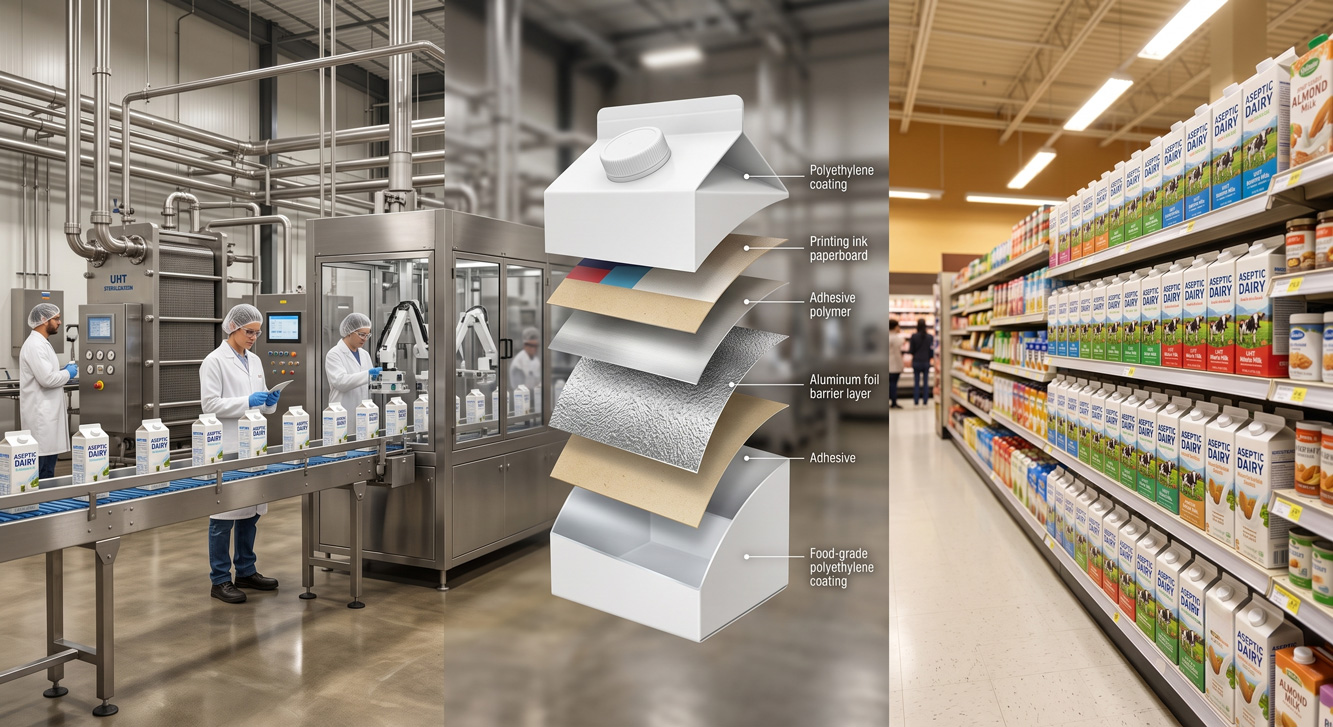


Executive Summary – Pin-hole defects in multi-layer foil laminations represent a critical failure mode in aseptic liquid packaging, directly compromising oxygen barrier integrity, product shelf life, and brand safety. During high-speed folding operations (exceeding 300 m/min), ultra-thin aluminum foil layers (6–12 µm) are subjected to mechanical stresses that can induce microscopic tears—typically 10–50 µm in diameter—which, if penetrating the full laminate structure, create pathways for oxygen and microbial ingress. Predictive modeling combining web tension analysis, surface energy measurements, and real-time electrical integrity testing enables manufacturers to detect and prevent these defects before they reach the filling line. This article examines the mechanical, chemical, and process-related root causes of pin-hole formation during high-speed folding and presents a comprehensive framework for prediction, detection, and mitigation.
1. The Critical Role of Foil Barriers in Aseptic Packaging
Aluminum foil serves as the primary oxygen and light barrier in aseptic gable top cartons. Its function is non-negotiable: without an intact foil layer, the extended shelf life (6–18 months) that defines aseptic packaging is unattainable.
1.1 Why Aluminum Foil?
Aluminum foil provides:
- Complete oxygen barrier – OTR approaching zero when defect-free
- Total light block – 100% opacity protecting photosensitive nutrients
- Microbial barrier – Physical prevention of bacterial ingress
- Formability – Ability to conform to carton geometry during folding
1.2 The Thinness Challenge
Typical foil thickness in aseptic cartons ranges from 6 to 12 micrometers—approximately one-tenth the diameter of a human hair. At these thicknesses, the foil is inherently susceptible to:
Critical Insight: Aluminum foil below 1.0 mil (25.4 µm) is “seldom, if ever, perfect.” Pin-hole counts increase as thickness decreases.
2. Pin-Hole Defects: Definition and Classification
2.1 What Is a Pin-Hole?
A pin-hole is a microscopic perforation in the aluminum foil layer, typically ranging from 10 to 50 µm in diameter—smaller holes tend to be circular, while larger holes (up to 75 µm × 200 µm) are often oval in shape.
2.2 Real vs. Pseudo Defects
Critical distinction for quality control:
Key Point: The human eye and most vision systems cannot distinguish between a through-hole and a foil-layer pin-hole. They have very different effects on barrier properties.
2.3 Why Pin-Holes in Foil Alone May Not Compromise Barrier
Counterintuitively, the presence of small pin-holes or fractures in the foil layer only has “very little impact on the WVTR or O2TR of the material”. The polymer sealant layer and adhesive layers can bridge these microscopic gaps, maintaining overall barrier performance.
However, if the pin-hole extends through the entire laminate, both gas and sterile barriers may be lost.

3. Pin-Hole Formation During High-Speed Folding: Root Cause Analysis
High-speed folding operations (300+ m/min) create conditions where pin-hole defects are most likely to form.
3.1 Mechanical Root Causes
a) Uneven Web Tension
“The main cause of micro-fractures when running ultra-thin flexible packaging aluminium foil at speeds over 300 m/min is uneven web tension. If the tension is a little too high, the foil exceeds its elongation limit and develops microscopic tears that look like pinholes.”
| Tension Issue | Result |
|---|---|
| Excessive tension | Foil exceeds elongation limit (~1-2%) |
| Uneven tension | Localized stress concentrations |
| Tension spikes | Sudden micro-fractures |
Prediction Parameter: Web tension monitoring with closed-loop control systems is essential for pin-hole prevention.
b) Mechanical Misalignment
A slight misalignment, bearing vibration, or worn-out nip roller can cause localized stress that punctures the foil as it passes through the laminating matrix.
| Mechanical Factor | Failure Mode |
|---|---|
| Roller misalignment | Uneven pressure distribution |
| Bearing vibration | Cyclical stress concentration |
| Worn nip roller | Localized high-pressure points |
c) Folding-Induced Stress
During the gable top folding operation, the laminate is subjected to:
- Sharp creasing along score lines
- 180-degree folding of the top panels
- Heat and pressure application during sealing
These operations create localized bending stresses that can exceed the foil’s fracture threshold, particularly in areas where the paperboard crease creates a stress concentration point.
3.2 Chemical Root Causes
a) Surface Oil Residue
Rolling oils are applied during aluminum foil manufacturing to lubricate and cool the metal. If the final annealing process does not completely burn these residues away, the foil will have a low wetting tension (dyne level).
| Result | Consequence |
|---|---|
| Low dyne level | Adhesive cannot wet out evenly |
| Dry spots/air pockets | Unsupported foil areas |
| High nip pressure | Unsupported foil “pops” creating micro-voids |
b) Non-Metallic Inclusions
The presence of non-metallic inclusions in the foil structure creates stress concentration points that can initiate cracks during folding.
3.3 Material Root Causes
a) Alloy Purity
“Your lamination process is only as good as the metal you put into it.”
Higher-purity alloys (e.g., 1235 O aluminum foil) provide more uniform grain structure and better tensile strength, enabling the foil to stretch smoothly under high-speed lamination pressure.
b) Foil Temper
Soft temper foil adapts to high-speed lamination machines without tearing, while hard temper foils are more prone to fracture.
4. Predicting Pin-Hole Defects: A Multi-Factor Model
4.1 The Prediction Framework
Effective pin-hole prediction requires integrating data from three domains:
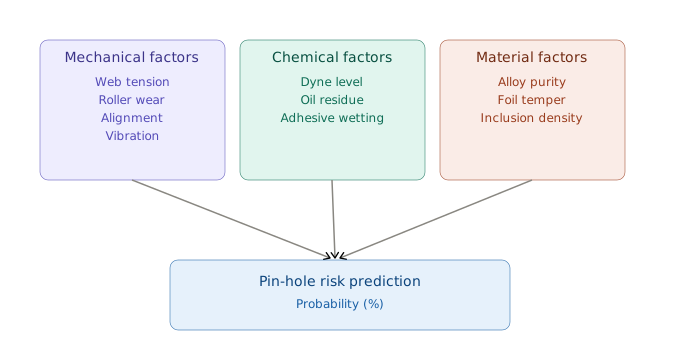
4.2 Key Predictive Parameters
| Parameter | Measurement Method | Threshold | Action |
|---|---|---|---|
| Web tension | Closed-loop tension sensors | ±5% of setpoint | Adjust dancer rollers |
| Dyne level | Dyne test pens | > 38 dynes/cm | Adjust annealing |
| Foil thickness | Continuous gauge monitoring | ±5% of nominal | Reject out-of-spec rolls |
| Roller runout | Dial indicator | < 0.02 mm | Schedule maintenance |
| Pin-hole count (incoming) | Online pinhole inspection | < 50/m² | Reject or downgrade |
4.3 Predictive Modeling Approaches
a) Statistical Process Control (SPC)
Monitor key parameters in real-time and establish control limits. When parameters drift toward warning limits, predictive alerts trigger preventive actions.
b) Machine Learning Models
Train models on historical data correlating process parameters with pin-hole rates. Feature sets include:
- Tension readings
- Temperature profiles
- Speed variations
- Roller wear metrics
- Incoming foil quality data
c) Finite Element Analysis (FEA)
Model the stress distribution during folding operations to identify:
- High-stress concentration zones
- Optimal crease geometries
- Critical folding speeds
5. Pin-Hole Detection Technologies
5.1 Electrical Integrity Testing
How it works: A defined voltage is applied between a probe electrode and a grounded conductive backing. If a discontinuity exists within the film, a brief current passes through the defect, triggering a visible and audible indication.
5.2 Cyclic Voltammetry (CV)
This method detects pin-holes by applying a varied voltage and measuring the induced current. Key features:
- Distinguishes between real and pseudo defects
- Current is proportional to pin-hole size and applied voltage
- Can detect cracks only on the inner layer exposing foil
5.3 Optical Inspection
Backlighting systems can detect pin-holes down to 10 µm in diameter in unsupported foil. However, coatings and adhesives in the final laminate significantly reduce visibility.
6. Prevention and Mitigation Strategies
6.1 Material Selection
| Strategy | Implementation |
|---|---|
| High-purity alloys | 1235 O foil with uniform grain structure |
| Soft temper | Better formability under high-speed folding |
| Strict quality control | Online pinhole inspection of incoming foil |
6.2 Process Optimization
6.3 In-Line Quality Control
| Strategy | Implementation |
|---|---|
| Real-time pinhole detection | Electrical integrity testing on the production line |
| Statistical process control | Monitor key parameters; establish control limits |
| Automated rejection | Remove defective material before filling |
7. The ASQ Packing Advantage
At ASQ Packing Group, we integrate advanced pin-hole prediction and detection technologies into our gable top carton manufacturing process.
7.1 Our Technical Capabilities
- Incoming material inspection: Online pinhole inspection of all foil laminates
- Closed-loop tension control: Real-time monitoring and adjustment during lamination
- Electrical integrity testing: 100% inspection of finished carton blanks
- Statistical process control: Continuous monitoring of all critical parameters
- Material expertise: Selection of high-purity alloys and optimized foil temper
7.2 Quality Guarantees
| Parameter | ASQ Packing Standard |
|---|---|
| Pin-hole rate (incoming) | < 50/m² |
| Pin-hole rate (finished) | < 5/m² |
| Barrier integrity | 100% tested via electrical methods |
| Shelf life (aseptic) | Up to 18 months |
As the future of sustainable beverage packaging continues to evolve, pin-hole prevention will remain a cornerstone technology for aseptic carton performance.
8. Conclusion: From Defect Detection to Predictive Prevention
Pin-hole defects in multi-layer foil laminations represent one of the most significant quality challenges in aseptic packaging manufacturing. However, the shift from reactive defect detection to predictive prevention is now achievable through:
- Understanding root causes – mechanical, chemical, and material factors
- Implementing predictive models – integrating tension, surface energy, and material data
- Deploying advanced detection – electrical integrity testing and cyclic voltammetry
- Optimizing processes – closed-loop control and regular maintenance
The result is higher yields, longer shelf life, and greater consumer confidence in your brand.
Frequently Asked Questions
1. What is a pin-hole defect in foil lamination?
A pin-hole is a microscopic perforation in the aluminum foil layer, typically 10–50 µm in diameter. If it penetrates the entire laminate, it can compromise the oxygen and microbial barrier.
2. What causes pin-holes during high-speed folding?
The primary causes are uneven web tension (exceeding the foil’s elongation limit), mechanical misalignment, surface oil residues preventing adhesive wetting, and non-metallic inclusions in the foil.
3. Do all pin-holes compromise barrier properties?
No. Pin-holes in the foil layer only (not penetrating the entire laminate) have “very little impact on the WVTR or O2TR of the material”. Only through-holes compromise the complete barrier.
4. How can pin-holes be detected?
Electrical integrity testing applies a voltage across the material and detects current flow through defects. Cyclic voltammetry distinguishes between real and pseudo defects. Optical inspection can detect pin-holes in unsupported foil.
5. What is the difference between a real defect and a pseudo defect?
A real defect is a pin-hole penetrating the entire laminate, compromising the barrier. A pseudo defect is a crack or pin-hole in the foil layer only, with the laminate still intact.
6. How can pin-hole defects be prevented?
Prevention strategies include using high-purity alloys, closed-loop tension control, proper annealing to remove oil residues, regular maintenance of rollers, and in-line electrical integrity testing.
Ready to Engineer Your Next Aseptic Packaging Solution?
Whether you need refrigerated cartons or aseptic cartons for global export, ASQ Packing Group has the technical expertise and manufacturing capability to deliver defect-free, high-performance packaging.
👉 Contact us at ASQ Packing to discuss your technical requirements, request samples, or schedule a facility tour.