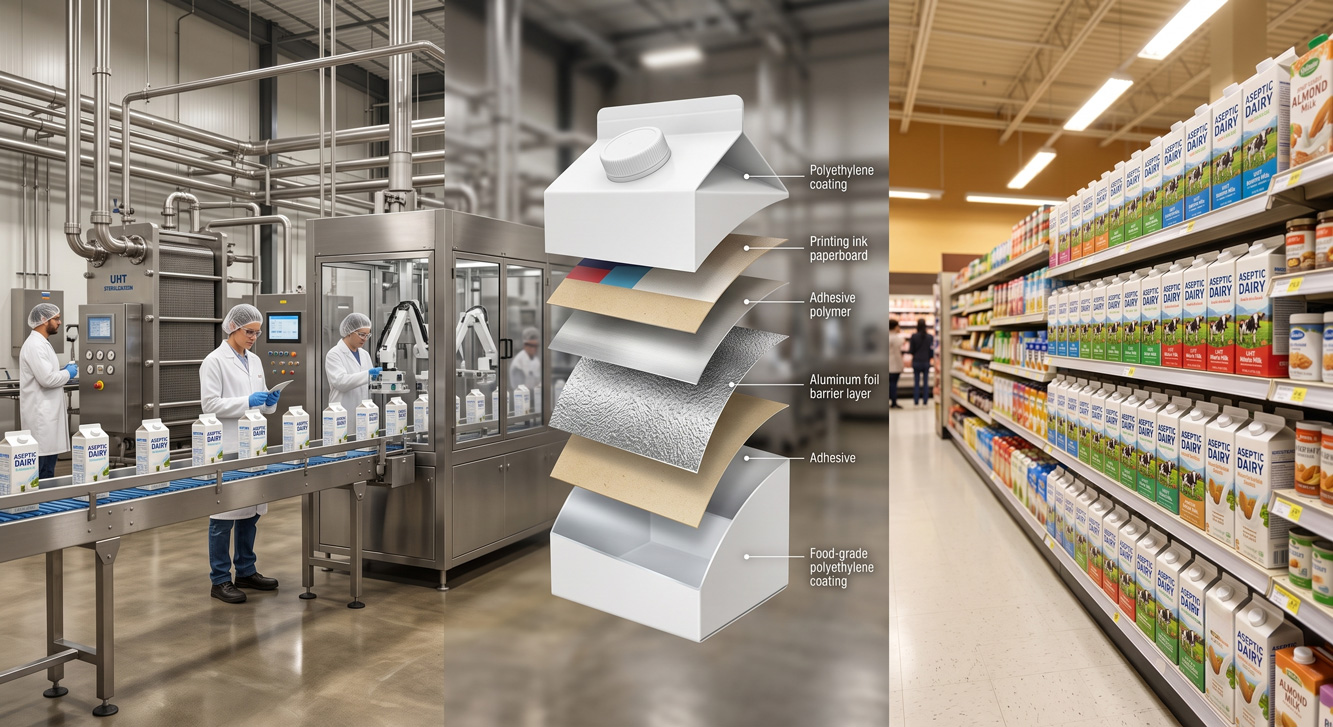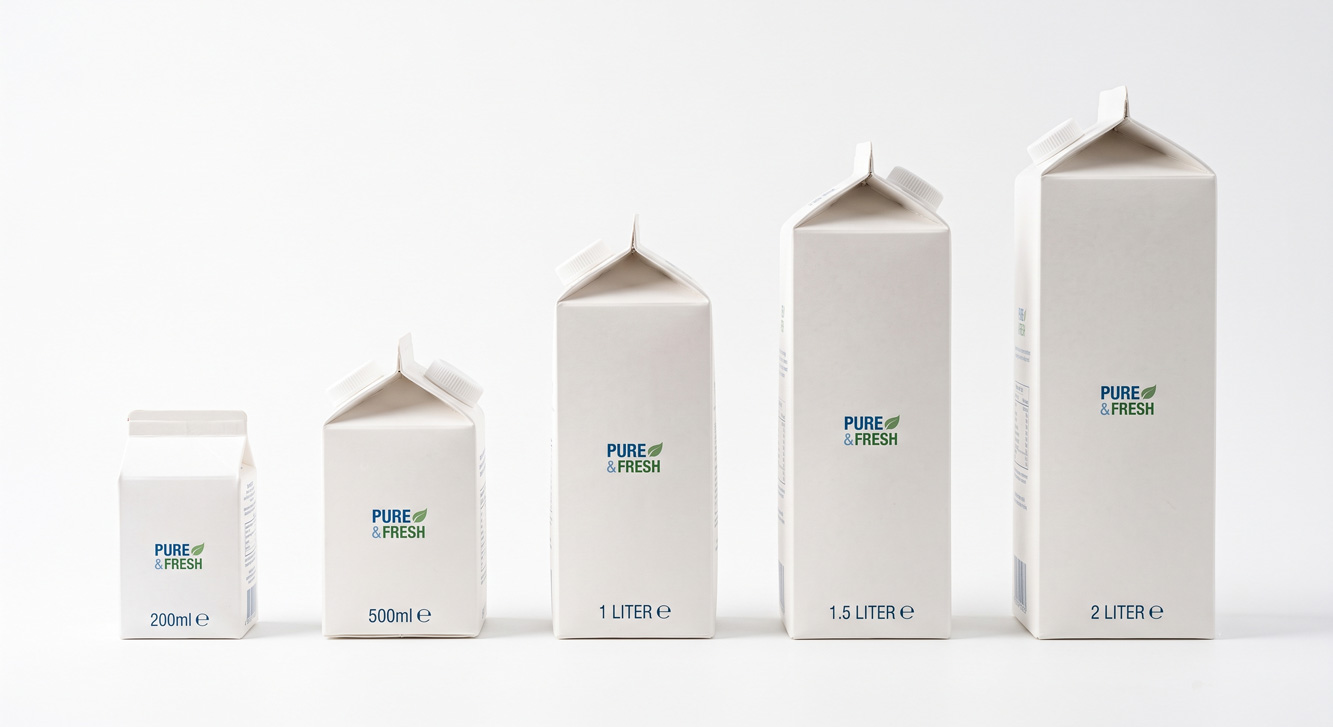


Executive Summary – Ultrasonic sealing is a high-performance, non-thermal joining technology that uses high‑frequency mechanical vibrations (typically 20, 30, or 35 kHz) to generate localized frictional heat directly within the thermoplastic sealing layers of a carton. Unlike conventional heat sealing, which applies external heat through heated jaws, ultrasonic sealing creates heat at the molecular level where the materials meet. This enables sealing times as short as 80 to 200 milliseconds, eliminates the need for an aluminum layer required by induction sealing, and reliably seals through product contamination. For aseptic carton manufacturers, ultrasonic sealing delivers higher production speeds, lower energy consumption (up to 75% less than other welding processes), and superior seal integrity—all while using cold tools that protect heat‑sensitive products. The process is supported by real‑time monitoring systems that enable quality assessment through parameter comparison, making it one of the most controllable sealing technologies in modern aseptic packaging.
The Physics of Ultrasonic Sealing: How It Works
Ultrasonic sealing is fundamentally different from traditional thermal sealing methods. Rather than applying heat from an external source, it generates heat precisely where it is needed: at the interface of the materials being joined.
From Electrical Energy to Molecular Bond
The ultrasonic sealing system converts electrical energy into high‑frequency mechanical vibrations through a carefully engineered acoustic stack:
| Component | Function |
|---|---|
| Converter (Transducer) | Converts electrical energy into mechanical vibration |
| Booster | Amplifies the vibration amplitude |
| Sonotrode (Horn) | Delivers the ultrasonic energy to the sealing area |
| Anvil | Provides a backing surface and focuses pressure |
The sonotrode and anvil focus the ultrasonic energy precisely at the point where the seal is to be formed. The high‑frequency mechanical vibrations are transmitted through the thermoplastic layers, generating frictional heat at the molecular level. This heat melts the plastic material, and when held under pressure by the sealing anvil, the molecules bond together to create a strong, hermetic seal.
Molecular Friction vs. External Heat
The key distinction lies in where the heat is generated:
- Heat Sealing: Heat is applied externally through heated jaws and conducts through the material layers
- Ultrasonic Sealing: Heat is generated internally through molecular friction at the bonding interface
This internal heat generation means the sealing tools themselves remain cold. The cold tools support rapid heat dissipation, resulting in significantly higher hot‑tack resistance (the strength of the seam immediately after welding, without cooling) compared to other sealing methods.
The 100–200 Millisecond Seal
The ultrasonic sealing process is remarkably fast. Typical sealing times range from 80 to 200 milliseconds. Energy is only consumed during the actual sound exposure, making the process highly energy‑efficient. Ultrasonic systems are ready for operation immediately upon switch‑on, unlike permanently heated heat‑contact processes that require warm‑up time.
Ultrasonic Sealing in Aseptic Carton Applications
In aseptic carton filling lines, ultrasonic sealing is used for multiple critical seal types, each serving a distinct function in package integrity.
Top Seal (Gable Top Fin Seal)
The top seal—often the gable top fin—is one of the most demanding sealing applications in carton packaging. The carton is filled with product, and the top must be sealed above the fill level to create a hermetic barrier.
Ultrasonic sealing excels in this application because:
- Liquid Displacement: The ultrasonic vibrations reliably displace liquid from the sealing area, preventing product ingredients from becoming trapped in the seam. This is a critical advantage for aseptic product safety.
- Sealing Through Contamination: Even in dusty filling environments or with product residue present, ultrasonic sealing achieves reliable joint quality. However, it should be noted that seal strength may be reduced compared to clean surfaces; careful parameter optimization is therefore essential.
- High Production Speeds: The process enables extremely high production rates with minimal reject rates.
- No Aluminum Layer Required: Unlike induction sealing, ultrasonic sealing does not require a conductive aluminum layer in the packaging material. This is a significant advantage for sustainability and recyclability.
For gable‑top cartons specifically, the top fin is sealed by a pair of jaws that apply ultrasonic energy to create a gas‑and‑liquid‑tight seal. The interface can have multiple layers—up to four or five layers depending on how the carton blank is folded—and ultrasonic sealing can reliably seal such complex geometries.
Longitudinal Seal (Manufacturer’s Joint)
The longitudinal seal runs the full height of the carton and forms the manufacturer’s joint—the seam that creates the tube from the flat carton blank. In roll‑fed aseptic filling machines, the packaging material is formed into a tube by sealing together opposing ends of the web.
Ultrasonic sealing is particularly well‑suited for the longitudinal seal because:
- No Layer Jumps Required: Unlike some other sealing technologies, ultrasonic sealing does not require layer jumps, making it ideal for mono‑material or multi‑layer structures.
- Minimum Film Overlap: The process saves packaging material due to minimum film overlap requirements.
- No Thermal Influence on Product: Cold sealing tools eliminate thermal stress on the product and the film.
Transversal Seal (Cross Seal)
The transversal seal is made across the width of the formed tube to create the bottom and top seals of individual packages. In aseptic filling, thousands of packages are produced per hour, leaving minimal margins for error.
Ultrasonic sealing offers distinct advantages for transversal sealing:
- Hermetic Seals Through Contamination: The mechanical vibrations “knock off” (displace) any product residues from the sealing area.
- Reduced Headspace: The narrow sealing seams reduce headspace volume and enable the use of less packaging material.
- Cold Process: The sealing jaws remain closed until the film is cold, reducing stress on the seal.

Ultrasonic vs. Induction Sealing: A Technical Comparison
The choice between ultrasonic and induction sealing is a critical decision in aseptic carton manufacturing. Each technology has distinct characteristics that influence seal quality, production efficiency, and sustainability.
| Criterion | Ultrasonic Sealing | Induction Sealing |
|---|---|---|
| Heat Generation | Internal (molecular friction) | External (eddy currents in aluminum layer) |
| Aluminum Layer Required | No | Yes (conductive layer required) |
| Seal Time | 80–200 milliseconds | Longer (requires heat generation and cooling) |
| Seal Through Contamination | Yes (vibrations displace residue) | Limited |
| Energy Consumption | Low; only during sealing cycle | Higher; continuous heating required |
| Tool Temperature | Cold tools | Hot tools (require heating and cooling) |
| Recyclability Impact | Compatible with mono‑materials | Aluminum layer hinders recyclability |
| Maintenance | Stable; easier to maintain | More complex; frequent checks needed |
Technical Note: Breakage of the aluminum foil along the joint interface has been observed in ultrasonic sealing applications involving multilayer structures containing aluminum. This occurs due to the mechanical stress induced by the high‑frequency vibrations. Therefore, when sealing aluminum‑containing laminates, the process parameters must be carefully optimized to minimize the risk of foil fracture while maintaining seal integrity. This is not a limitation of the ultrasonic process per se, but rather a material‑process interaction that requires attention during development.
The Sustainability Advantage of Ultrasonic Sealing
One of the most significant advantages of ultrasonic sealing is its compatibility with sustainable packaging designs. Induction sealing requires a conductive layer in the packaging material—typically aluminum—to generate heat through eddy currents.
Ultrasonic sealing, by contrast, does not require an aluminum layer. This opens the door to:
- Mono‑Material Packaging: Ultrasonic sealing works well with multilayer mono‑materials, enabling more recyclable package designs.
- Aluminum‑Free Aseptic Cartons: The aluminum layer is not needed for sealing, allowing manufacturers to reduce material complexity.
- Reduced Material Usage: Narrower sealing seams save packaging material.
Key Process Parameters and Quality Assurance
Critical Parameters
Unlike hydrogen peroxide sterilization with its seven critical parameters, ultrasonic sealing depends on a smaller set of precisely controllable variables:
| Parameter | Description | Impact |
|---|---|---|
| Frequency | 20, 30, or 35 kHz | Determines vibration characteristics |
| Amplitude | Controlled via booster selection; typically 9–35 µm | Affects heat generation rate |
| Pressure | Applied by the sealing jaws | Ensures intimate contact for bonding |
| Exposure Time | 80–200 milliseconds | Determines total energy delivered |
| Energy | Total ultrasonic energy applied | Directly influences seal quality |
Real‑Time Process Monitoring
Modern ultrasonic sealing systems incorporate advanced monitoring capabilities:
- Parameter Storage: Sealing parameters can be stored in the ultrasonic generator’s memory, allowing automatic switch‑over among parameter sets for different products.
- Quality Assessment: The ultrasonic generator saves all data and enables quality assessment through reference/actual comparison.
- Fault Detection: High Definition Mode (HDM) allows detection of faulty conditions in the sealing area.
- Image‑Based Inspection: Advanced methods use image data sets to assess seal quality, identifying adherence and non‑adherence sections.
Seal Quality Metrics
| Metric | Target | Measurement Method |
|---|---|---|
| Peel Strength | Limited by paperboard failure | Tensile testing |
| Seal Integrity | Hermetic; no leakage | Dye penetration or vacuum testing |
| Seal Width | Narrow; material‑saving | Visual or optical measurement |
| Hot‑Tack Resistance | High | In‑line testing |
Advantages and Limitations of Ultrasonic Sealing
Advantages
| Advantage | Benefit |
|---|---|
| Cold Sealing Tools | No thermal damage to products or packaging materials |
| Sealing Through Contamination | Reliable seals despite product residue in seal area |
| High Speed | 80–200 millisecond cycle times |
| Low Energy Consumption | Up to 75% less energy than other welding processes |
| No Aluminum Required | Enables more sustainable, recyclable packaging |
| Narrow Seams | Saves packaging material |
| Immediate Start‑Up | No warm‑up time required |
| Reduced Cleaning Effort | Cold tools resist soiling |
Limitations
| Limitation | Consideration |
|---|---|
| Higher Initial Investment | Specialized components (converter, booster, sonotrode) increase capital expenditure |
| Material Compatibility | Works best with ultrasonically compatible films |
| Process Sensitivity | Requires careful parameter optimization for each material |
| Potential Aluminum Fracture | Breakage of aluminum foil along the joint interface can occur; parameters must be optimized to minimize this risk |
The ASQ Packing Advantage
At ASQ Packing Group , we engineer our multi‑layer aseptic cartons to perform with flawless precision on ultrasonic sealing equipment. Our material scientists calibrate polymer blends and layer structures to optimize ultrasonic energy transmission and seal formation.
Our Technical Capabilities:
- Ultrasonic‑Optimized Laminates: Custom‑engineered polymer layers for reliable ultrasonic sealing
- Aluminum‑Free Options: Sustainable packaging designs compatible with ultrasonic sealing
- FSC‑Certified Paperboard: Responsibly sourced materials
- In‑House Quality Control: FTIR, DSC, and tensile testing for seal validation
- Expert Technical Support: Material selection and process optimization for your specific filling line
For a comprehensive overview of aseptic filling technology, see our Ultimate Engineering Guide to Aseptic Filling Machines . To understand how ultrasonic sealing compares with other sealing technologies in different machine architectures, refer to our Web‑Fed vs. Blank‑Fed Machines in Aseptic Lines .
Frequently Asked Questions
1. What is the difference between ultrasonic sealing and heat sealing?
Heat sealing applies external heat through heated jaws to melt the material from the outside in. Ultrasonic sealing generates heat internally through molecular friction, melting the material from the inside out. Ultrasonic tools remain cold, enabling sealing times of 80–200 milliseconds.
2. Does ultrasonic sealing require an aluminum layer in the carton?
No. Unlike induction sealing, which requires a conductive aluminum layer to generate heat through eddy currents, ultrasonic sealing does not require aluminum. This is a significant advantage for sustainability and recyclability.
3. Can ultrasonic sealing seal through product contamination?
Yes. The mechanical vibrations “knock off” (displace) product residues from the sealing area, enabling tight seals even on contaminated surfaces. However, seal strength may be reduced compared to clean surfaces; careful parameter optimization is therefore essential.
4. How fast is ultrasonic sealing?
Ultrasonic sealing is extremely fast, with typical sealing times of 80 to 200 milliseconds. This enables high production speeds with minimal reject rates.
5. Is ultrasonic sealing more energy‑efficient than other methods?
Yes. Ultrasonic sealing uses up to 75% less electrical energy compared to other welding processes. Energy is only consumed during the actual sealing cycle.
6. What packaging materials are compatible with ultrasonic sealing?
Ultrasonic sealing works best with thermoplastic materials that can transmit mechanical vibrations. It is compatible with multilayer structures, mono‑materials, and coated carton boards. It is particularly effective for materials with a sealing layer that softens under friction‑generated heat.
7. Can ultrasonic sealing be used for both longitudinal and transversal seals?
Yes. Ultrasonic sealing is used for both longitudinal seals (the manufacturer’s joint that forms the tube) and transversal seals (the top and bottom seals of individual packages) in aseptic carton filling lines.
Ready to Optimize Your Aseptic Carton Sealing?
Whether you are evaluating ultrasonic sealing for a new packaging line or optimizing an existing operation, ASQ Packing Group has the technical expertise and manufacturing capability to support your needs.
👉 Contact us at ASQ Packing to discuss your sealing requirements, request samples, or schedule a technical consultation.