

In the high-stakes ecosystem of aseptic liquid packaging, the Form-Fill-Seal (FFS) machine is the ultimate bottleneck of operational efficiency. However, not all FFS machines are engineered equally. The fundamental division in this technology lies in how the packaging material is fed into the sterile zone: either as a continuous, flat Web-Fed roll or as pre-cut, flattened Blank-Fed sleeves.
For plant engineers and procurement managers, this choice dictates the entire lifecycle cost, maintenance schedule, and market flexibility of the production unit. This guide provides a deep engineering analysis to help you determine which architecture aligns with your facility’s strategic goals. For a broader understanding of the mechanical baseline, we recommend reviewing our complete aseptic filling machines engineering guide alongside this analysis.
The Web-Fed Architecture: Continuous High-Speed Efficiency
Web-fed technology remains the heavy-duty standard for high-volume, continuous production runs, such as standard UHT dairy or base commodity juices. The system operates on a seamless, vertical principle.
Operational Workflow and Sealing Mechanics
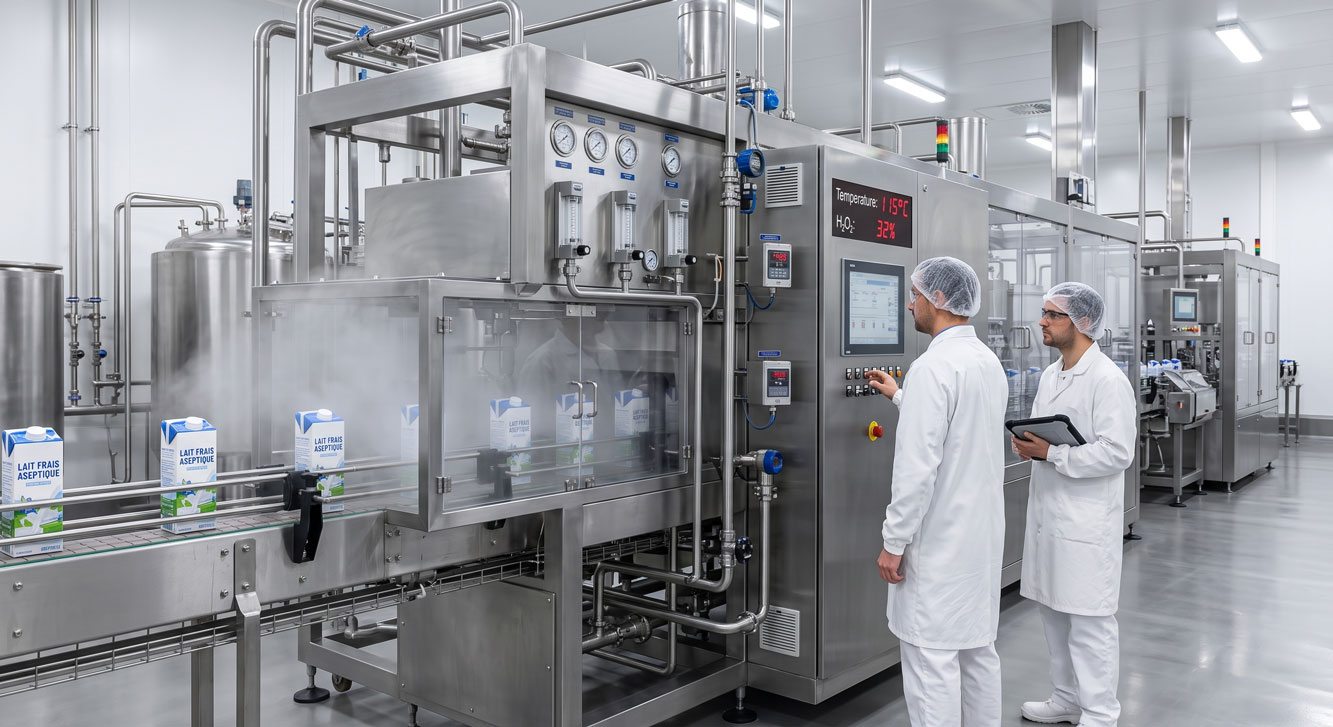
A massive, continuous roll of multi-layer laminate material (the “web”) is unwound and passed through a deep chemical sterilization bath. Inside the sterile chamber, the flat web is gradually folded into a tube. A precision longitudinal induction seal is applied, creating a continuous vertical cylinder.
Because the raw edge of the paperboard could potentially absorb liquid from the inside, the longitudinal seam on web-fed systems heavily relies on skiving and hemming technology to fold the inner polymer layers over the raw edge, completely protecting the structural integrity of the carton. Once sealed longitudinally, the sterile product is pumped in, and transversal induction jaws clamp, seal, and cut individual packages below the liquid level.
The Blank-Fed Architecture: Flexibility and Compact Design
Blank-fed machines, frequently deployed for premium product lines or facilities requiring rapid SKU turnovers, utilize pre-manufactured components. These are pre-cut laminate sheets that have already been folded, seamed longitudinally, and flattened into a “blank” or sleeve by the packaging supplier prior to delivery.
Operational Workflow and Dosing
The machine’s magazine is loaded with these flattened blanks. A mechanical arm utilizes pneumatic suction to open the blank into its final rectangular footprint. The bottom of the carton is folded and sealed first. The open-top carton is then sterilized using hydrogen peroxide vapor and UV light, filled with the sterile product from the top, and finally, the top geometry is sealed.
Technical Benchmarking: Web-Fed vs. Blank-Fed
The choice between these two systems requires a strict engineering trade-off between absolute throughput and operational agility. Below is a comparative matrix based on key B2B performance indicators:
| Performance Metric | Web-Fed (Roll-Fed) Technology | Blank-Fed (Sleeve) Technology |
| Throughput Capacity | Extremely High (up to 24,000 packs per hour) | Moderate to High (up to 12,000 packs per hour) |
| Changeover Time (Size) | High (Requires changing the entire roll and forming ring) | Extremely Low (Servo-driven, rapid automated adjustments) |
| Sterilization Method | Chemical Bath (Total immersion of flat web) | Spray/Vapor (Sterilization of a pre-formed open shape) |
| Initial Capital Investment | Extremely High | High |
| Material Wastage | Higher (Due to roll changes and web tensioning issues) | Minimal (Individual cartons are processed linearly) |
Strategic Link to Laminate Quality and Barrier Integrity
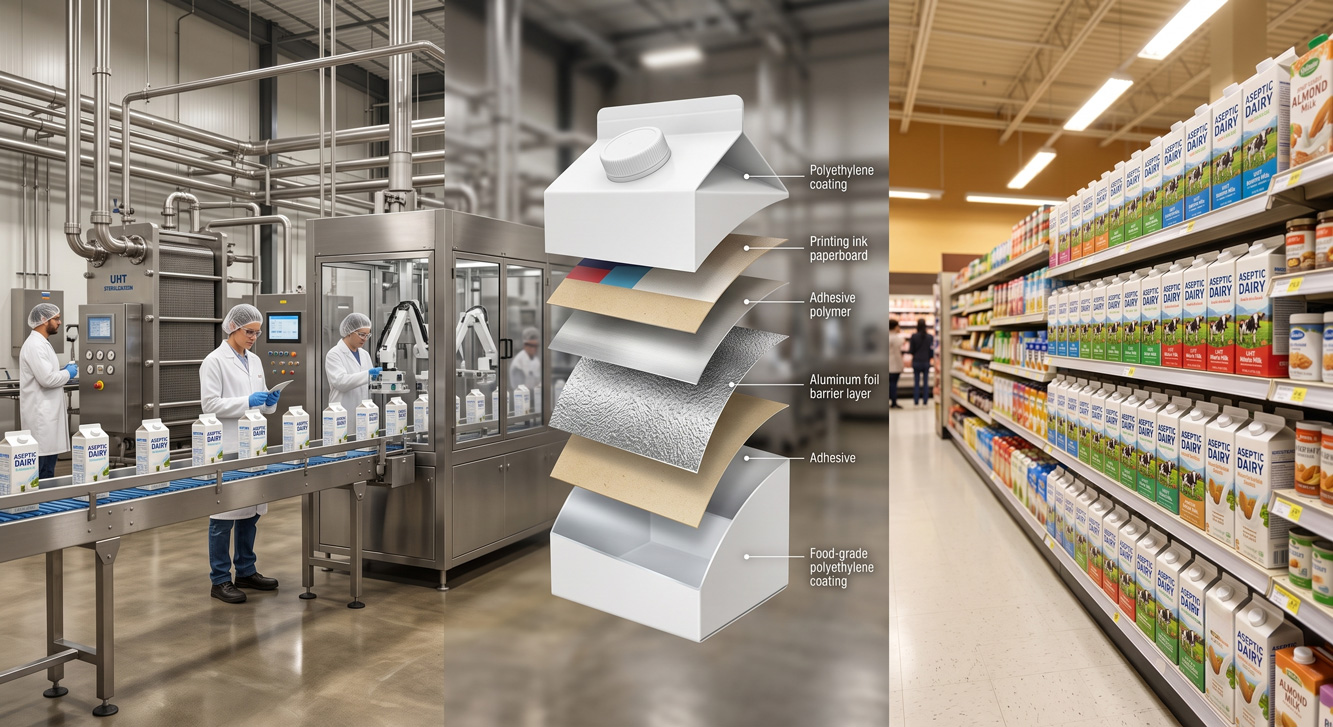
Both machine architectures rely entirely on the exact structural specifications of the laminate to maintain absolute Barrier Integrity. The way each machine handles the material dictates specific risks to the packaging’s barrier properties.
A web-fed machine requires exceptional material stiffness to maintain the vertical tube’s shape, yet enough flexibility to survive the rapid, continuous forming process. The critical risk here is Flex Cracking. High tension and aggressive mechanical folding on a roll-fed line can physically fracture the aluminum core. This micro-damage is a leading cause of pin-hole defects in foil lamination, which drastically increases the OTR (Oxygen Transmission Rate) and WVTR (Water Vapor Transmission Rate), leading to rapid product spoilage.
Conversely, in blank-fed machines, the barrier integrity is established long before the carton enters the aseptic line. The risk shifts from machine tension to the quality of the pre-manufactured seams. If the blanks suffer from poor Permeation controls during their initial converting and folding process, the barrier is already compromised. Flawless geometric alignment in blanks isn’t just about preventing mechanical line jams; it is crucial to ensure that the pre-sealed longitudinal edges and folded corners maintain a 100% continuous barrier against oxygen and moisture during the final top and bottom sealing phases.destroyed product.
Frequently Asked Questions (FAQ) on Aseptic Feeding Systems
Which system offers a lower total cost of ownership (TCO)?
For long, uninterrupted production runs of a single volume and product, Web-Fed machines offer a lower TCO due to their extreme speed. However, for a facility running multiple SKUs and frequent volume changes, Blank-Fed machines yield a lower TCO by dramatically reducing mechanical downtime during product changeovers.
Are the barrier properties different between the two formats?
No, the raw material laminate—including the critical aluminum foil and polyethylene layers—is fundamentally identical. The distinction lies entirely in whether it is supplied as a continuous roll or a pre-cut, pre-seamed blank.
Which machine type is better for handling particulate products like soups?
Blank-fed machines, operating with a horizontal flow and an open-top fill system, easily handle particulate products. They allow for unobstructed dosing and top-sealing without solid particles interfering with a continuous transversal sealing mechanism.
Engineering a Flawless Production Line with ASQ
The choice between Web-Fed and Blank-Fed technology is not about discovering a superior format; it is about perfect alignment with your facility’s operational DNA. At ASQ Packing, we engineer our multi-layer aseptic laminates to perform with flawless precision on your specific equipment.
Our material scientists calibrate the polymer blend and foil thickness of our rolls and blanks to match the exact temperature, pressure, and speed parameters of your line. Before finalizing your next contract, review the top 10 questions to ask your packaging supplier to ensure their technical capabilities align with your machine’s strict requirements.