
Executive Summary – Edge-wicking—the capillary-driven migration of liquid into the exposed raw edge of paperboard—is a primary failure mode in liquid packaging cartons. Skiving and hemming technology eliminates this risk by removing approximately 75% of the paperboard thickness along the fifth panel edge (skiving) and folding the remaining skived flap inward to create a sealed, fluid-impervious barrier (hemming). This two-step process prevents liquid from contacting the raw cellulose fibers, extending shelf life from days to over 12 months for aseptic applications. The technology is recognized globally as the gold standard for liquid-tight carton sealing.
1. The Problem: Why Raw Paperboard Edges Fail
Paperboard is a fibrous, porous material composed of cellulose fibers bonded by hydrogen bonds. While the board’s surfaces are coated with polyethylene (PE) or other polymer layers to create a liquid barrier, the cut edges—where the blank is sheared during die-cutting—remain exposed.
The Capillary Action Mechanism
When liquid contacts a raw paperboard edge, it is drawn into the fiber network through capillary action:
- The interfiber spaces act as microscopic capillaries (diameters of 10–100 micrometers)
- Surface tension pulls the liquid upward and laterally into the board
- The liquid migrates along the fiber walls, gradually saturating the board
Consequences of Edge-Wicking
| Consequence | Impact |
|---|---|
| Structural Weakening | Saturated fibers lose tensile strength; carton becomes prone to deformation or rupture |
| Seal Contamination | Liquid reaching the seal area compromises heat-seal integrity |
| Aesthetic Defects | Staining on the outer printed surface reduces shelf appeal |
| Microbial Growth | Moisture trapped in the fiber matrix creates a breeding ground for bacteria |
| Shelf Life Reduction | Even minor wicking accelerates spoilage, reducing product shelf life from months to days |
The Vulnerable Zone: The Fifth Panel
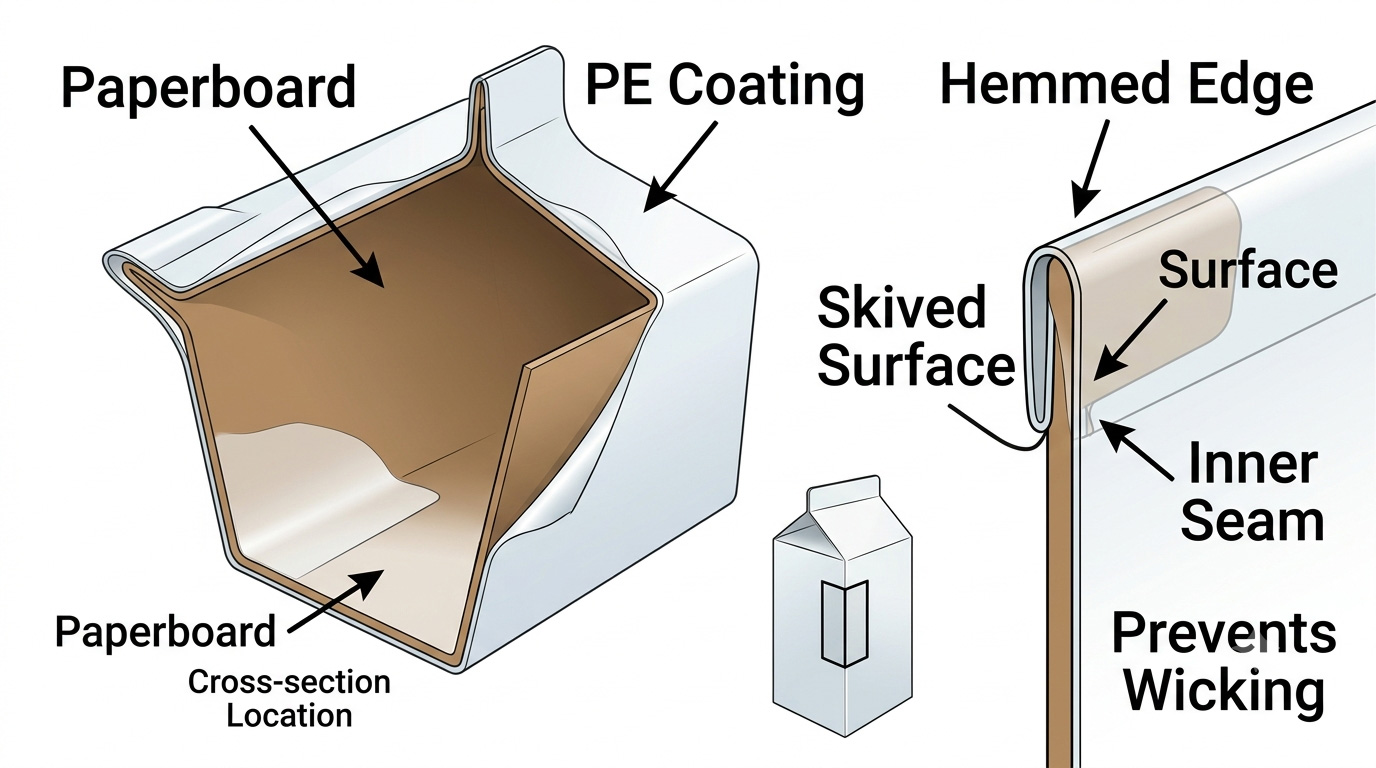
The fifth panel (also called the glue panel or side seam flap) is the most critical area for wicking risk. This panel forms the manufacturer’s joint—the longitudinal seam that runs the full height of the carton. In conventional cartons, the raw edge of this panel is exposed to the liquid contents, creating a direct pathway for wicking.
2. Skiving: The Precision Material Removal Process
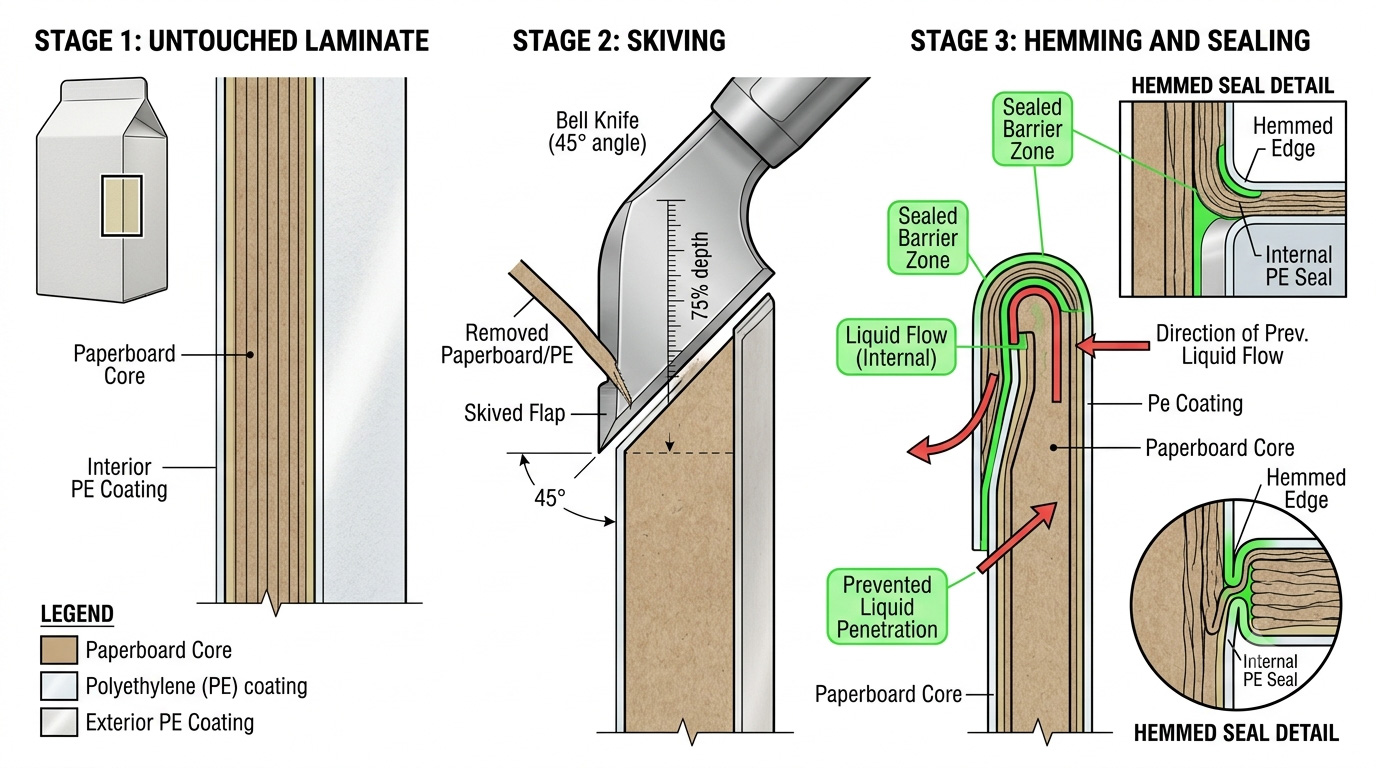
Skiving is the mechanical removal of a precise portion of the paperboard thickness along the edge of the fifth panel. This creates a “skived flap”—a thinned, flexible extension that can be folded without cracking or delaminating.
The Skiving Process
- Positioning: The carton blank is fed into a skiving machine
- Material Removal: A rotating bell knife (operating at 1,000–5,000 RPM) removes a strip of material from the fifth panel
- Precision Control: The skiving depth removes approximately 75% of the board thickness
- Width Specification: The skived area accounts for approximately one-third of the panel width
Technical Specifications
| Parameter | Typical Value | Function |
|---|---|---|
| Skiving depth | ~75% of board thickness | Creates thin, flexible flap |
| Skived width | ~33% of panel width | Provides sufficient material for hemming |
| Knife speed | 1,000–5,000 RPM | Clean, consistent cut |
| Feed speed | 0–100 m/min | Production rate flexibility |
| Remaining caliper | ~25% of original | Maintains structural integrity |
The Skived Flap Geometry
The skived flap is defined by a rabbeted portion extending into the exterior surface of the blank. This geometry ensures that:
- The flap folds inward toward the interior of the carton
- The fold occurs at the thinnest point, minimizing stress on the paperboard
- The resulting hem lies flat against the interior surface
Self-Sharpening Technology
Modern skiving machines incorporate self-sharpening bell knife systems that maintain cutting precision without operator intervention. Key features include:
- Automatic bell knife grinding without interrupting production
- Integrated grinding chamber with air filtration
- Knife life up to 800–1,000 hours of uninterrupted operation
- Low dust contamination and recyclable skiving scrap
3. Hemming: Sealing the Skived Edge
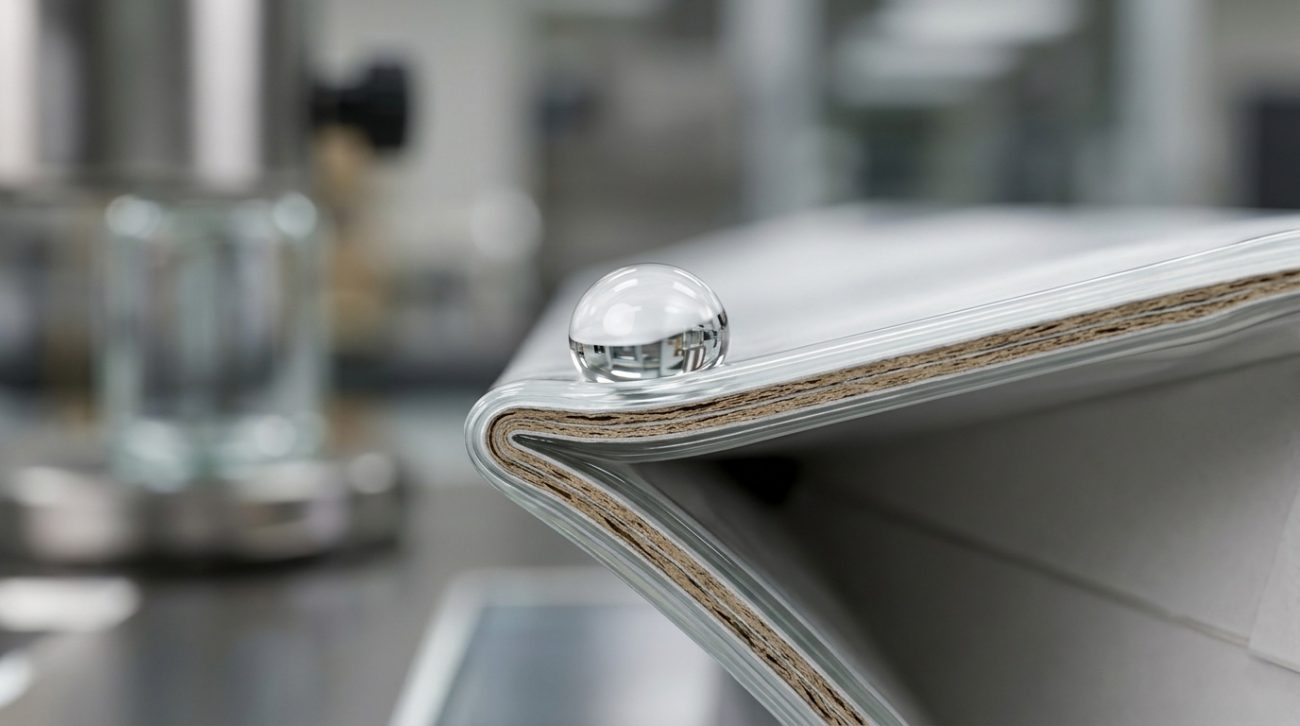
Hemming is the process of folding the skived flap inward and sealing it against the interior surface of the carton. This creates a protected, fluid-impervious edge that prevents liquid from contacting the raw cellulose fibers.
The Hemming Process
- Prefolding: The skived flap is pre-folded along the skived crease line
- Hem Formation: The flap is folded over onto the interior surface of the carton
- Heat and Pressure Application: Heat (150–180°C) and pressure (2–4 bar) activate the PE coating
- Sealing: The PE layer melts and fuses, creating a hermetic seal
Technical Specifications
| Parameter | Typical Value | Function |
|---|---|---|
| Fold angle | 180 degrees | Flap lies flat against interior surface |
| Heat temperature | 150–180°C | Activates PE sealant layer |
| Pressure | 2–4 bar | Ensures intimate contact for sealing |
| Dwell time | 0.5–1.5 seconds | Allows heat to penetrate and seal |
The Sealed Edge Structure
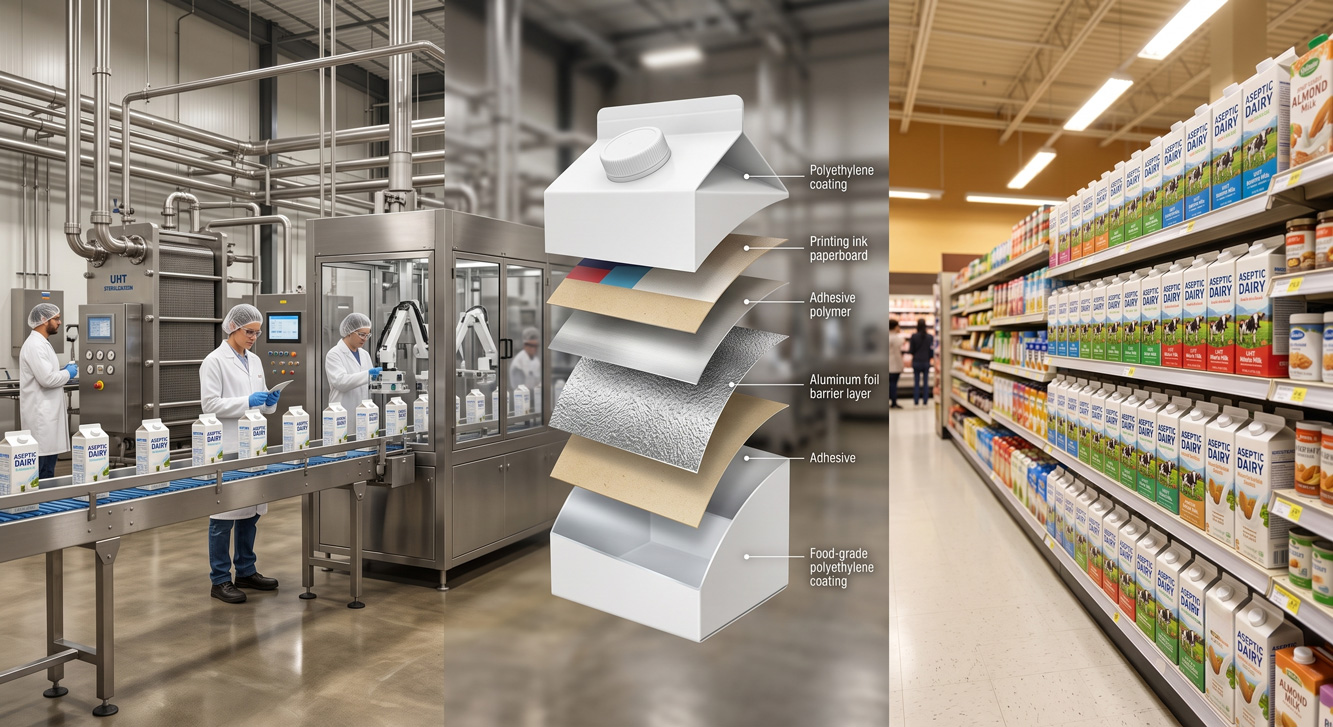
The hemmed edge creates a multi-layer barrier:
text
                    Interior of Carton (Liquid Side)
                               |
                               |  PE coating (sealant layer)
                               |  ───────────────────────
                               |  Hemmed flap (skived edge folded inward)
                               |  ───────────────────────
                               |  PE coating (bonding layer)
                               |  ───────────────────────
                               |  Paperboard (fifth panel)
                               |  ───────────────────────
                               |  PE coating (outer moisture barrier)
                               |
                    Exterior of Carton
How It Prevents Wicking:
- The raw edge of the paperboard is folded away from the liquid
- The folded hem is encapsulated in PE on both sides
- The heat-sealed bond creates a continuous barrier with no exposed fibers
- The liquid cannot access the cellulose fibers because they are sealed behind PE
Hemming and the “Fifth Panel” Protection
The fifth panel raw edge, located on the inside of the carton, is the primary target of skiving and hemming. By folding and sealing this edge, the technology:
- Eliminates the capillary pathway for liquid migration
- Prevents liquid penetration into the paperboard
- Extends liquid-tight packing shelf life
4. Comparative Analysis: Skiving & Hemming vs. Alternative Methods
| Method | Mechanism | Effectiveness | Key Limitation |
|---|---|---|---|
| Skiving & Hemming | Physical removal + folding + heat sealing | High – eliminates capillary pathways | Requires specialized equipment |
| Edge Coating | Application of hydrophobic material to raw edge | Moderate – coating can wear or crack | Inconsistent coverage over time |
| Flame Sealing | Melting PE coating over raw edge | Moderate – inconsistent coverage | Requires precise heat control |
| Adhesive Sealing | Glue application to raw edge | Low – glue can degrade over time | Limited durability |
| Folding Under | Folding raw edge under the panel | Low – can unfold | Inconsistent protection |
Why Skiving & Hemming Is Superior
- Permanent Protection: The hemmed edge is heat-sealed, creating a permanent bond that cannot degrade over time
- Complete Coverage: The skived flap covers the entire length of the fifth panel edge
- No Exposed Fibers: The raw edge is completely encapsulated in PE
- Compatibility: Works with existing flame-sealing and heat-sealing equipment
5. The Role of Skiving and Hemming in Aseptic Packaging
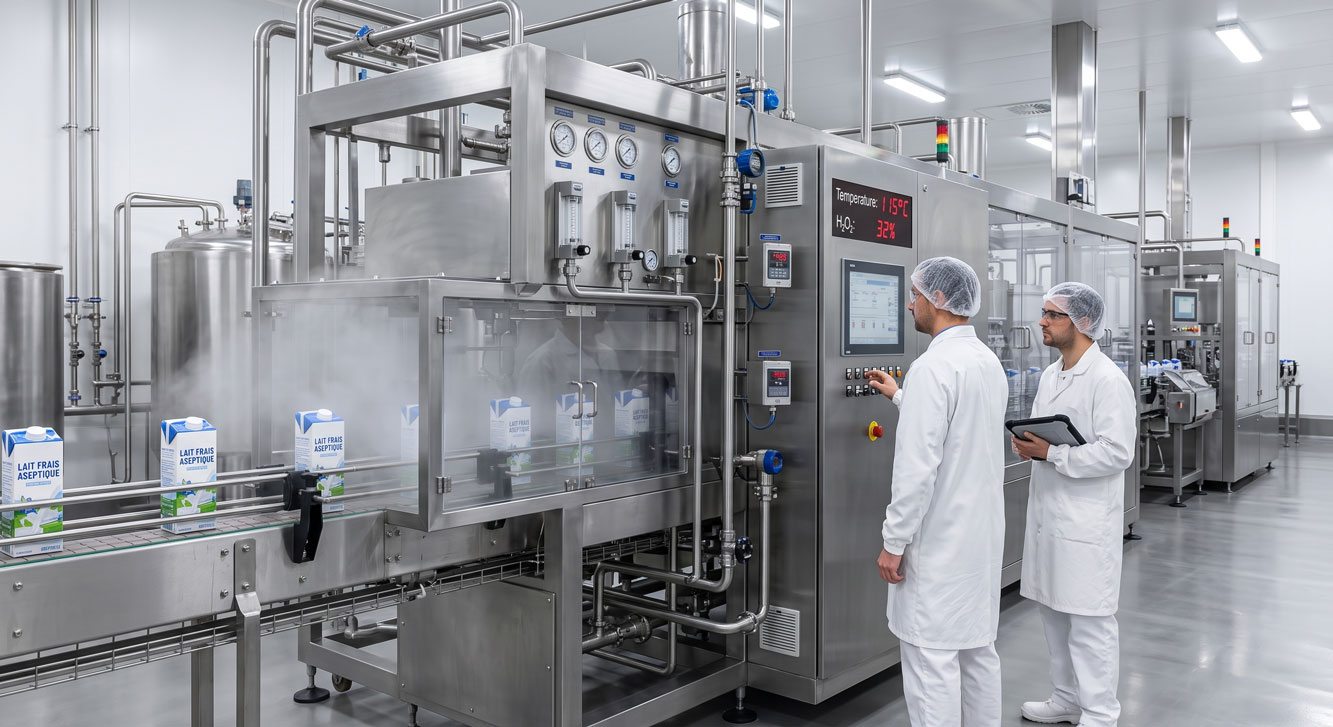
In aseptic packaging, where the carton and product are sterilized separately and filled in a sterile environment, edge protection is even more critical. This is particularly important when considering the comparison of gable top cartons and PET bottles, where the seal integrity of paperboard cartons must match or exceed the performance of plastic alternatives.
Hydrogen Peroxide Exposure Challenges
- H₂O₂ is a strong oxidizing agent that can degrade cellulose fibers
- Penetration of H₂O₂ into the board can lead to aesthetic and functional defects
- Residual H₂O₂ can affect product quality and safety
How Skiving & Hemming Addresses Aseptic Requirements
- Protected Edges: The hemmed edge prevents H₂O₂ from penetrating the board
- Hermetic Seal: The sealed hem creates a complete barrier against both liquid and sterilant penetration
- Extended Shelf Life: The combination of skiving, hemming, and barrier layers enables shelf life of 6–18 months without refrigeration
These capabilities directly support the benefits of cartons for milk packaging, where extended freshness and nutrient preservation are paramount.
The Koenig & Bauer Liquitec Phoenix flame sealer, for example, incorporates skiving and hemming ability to run high-speed aseptic liquid packaging cartons to the most accurate tolerances achievable.
6. Advanced Manufacturing and Quality Control
Integration with Printing and Customization
Skiving and hemming technology must be precisely integrated with the carton’s printing and finishing processes. As detailed in our custom printed gable top cartons guide, the skiving operation must not interfere with the printed graphics or the structural integrity of the carton’s decorative surfaces.
Quality Assurance Protocols
| Test | Method | Acceptance Criteria |
|---|---|---|
| Skiving depth | Optical micrometer | 75% ± 3% of board thickness |
| Hem seal integrity | Peel strength test | > 25 N/15 mm |
| Edge wicking test | Dye penetration test | Zero dye migration along skived edge |
| Leak test | Vacuum chamber | Zero leakage at -0.5 bar |
7. Why This Technology Matters for Brand Owners
For beverage and dairy brands, skiving and hemming technology is not just a manufacturing detail—it is a critical quality differentiator that directly impacts:
- Product Safety: Prevents microbial contamination through liquid ingress
- Shelf Life: Enables extended distribution without spoilage
- Brand Reputation: Eliminates leaks and staining that damage consumer trust
- Sustainability: Reduces food waste by maintaining product integrity longer
As discussed in why brands are switching to gable top cartons, skiving and hemming is one of the key technical advantages that makes paperboard cartons a superior alternative to plastic bottles.
8. The ASQ Packing Advantage
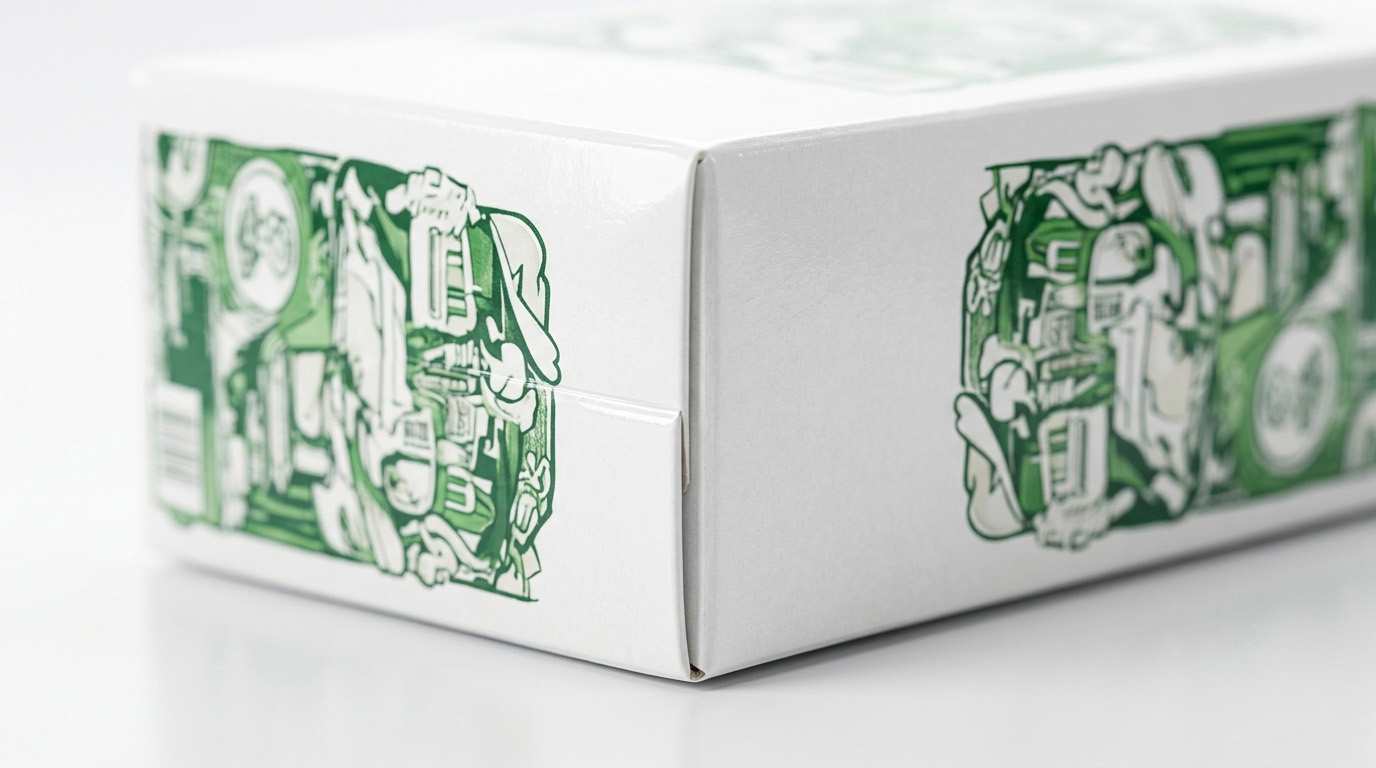
At ASQ Packing Group, we integrate skiving and hemming technology into our gable top carton manufacturing process to deliver products that meet the highest standards of liquid-tight integrity.
Our Technical Capabilities
- Precision Skiving: Automated skiving stations with self-sharpening bell knife systems
- Controlled Hemming: Heat and pressure-controlled hemming stations with micrometer adjustments
- Quality Assurance: In-process inspection for skiving depth, hem integrity, and seal strength
- Material Expertise: FSC-certified paperboard with optimized PE coating for superior sealing
Performance Guarantees
| Parameter | ASQ Packing Standard |
|---|---|
| Skiving depth | 75% ± 3% of board thickness |
| Hem seal strength | > 25 N/15 mm |
| Leak test | Zero leakage at -0.5 bar vacuum |
| Shelf life (refrigerated) | Up to 45 days |
| Shelf life (aseptic) | Up to 18 months |
As the future of sustainable beverage packaging continues to evolve, skiving and hemming will remain a cornerstone technology for liquid-tight carton performance.
9. Conclusion: The Science of a Perfect Seal
Edge-wicking is not a minor defect—it is a fundamental failure mechanism that can compromise product safety, reduce shelf life, and damage brand reputation. Skiving and hemming technology provides the only comprehensive solution:
- Skiving removes the vulnerable material thickness, creating a flexible flap
- Hemming folds and seals this flap, eliminating all exposed raw edges
- Heat sealing creates a permanent, fluid-impervious bond that lasts the life of the carton
The result is a hermetic seal that prevents liquid penetration—whether the product is fresh milk, juice, plant-based beverage, or a flavor-sensitive condiment.
Frequently Asked Questions
1. What is edge-wicking in paperboard cartons?
Edge-wicking is the capillary-driven migration of liquid into the exposed raw edge of paperboard. The liquid is drawn along the cellulose fibers, eventually saturating the board and compromising its structural integrity and seal performance.
2. How does skiving prevent wicking?
Skiving removes approximately 75% of the paperboard thickness along the edge of the fifth panel. This reduction in thickness allows the edge to be folded and sealed without cracking or delamination.
3. What is the role of hemming in liquid cartons?
Hemming folds the skived flap inward and heat-seals it against the interior carton surface. This creates a protected edge where the raw paperboard fibers are completely encapsulated in PE, preventing liquid contact.
4. How does skiving and hemming extend shelf life?
By preventing liquid from wicking into the paperboard, the technology eliminates the primary pathway for spoilage. This enables extended shelf life—up to 45 days for refrigerated products and up to 18 months for aseptic applications.
5. Is skiving and hemming compatible with existing filling equipment?
Yes. The hemmed carton blanks are designed to work with standard flame-sealing and heat-sealing equipment. The technology has been widely adopted in the liquid packaging industry since its patenting.
6. What is the skiving specification for fifth panel processing?
As a general rule, the skived surface should not exceed one-third of the total panel width. The skiving depth removes approximately 75% of the board thickness, leaving approximately 25% remaining.
Ready to Engineer Your Next Liquid Packaging Solution?
Whether you need refrigerated cartons for local distribution or aseptic cartons for global export, ASQ Packing Group has the technical expertise and manufacturing capability to deliver.
👉 Contact us at ASQ Packing to discuss your technical requirements, request samples, or schedule a facility tour.