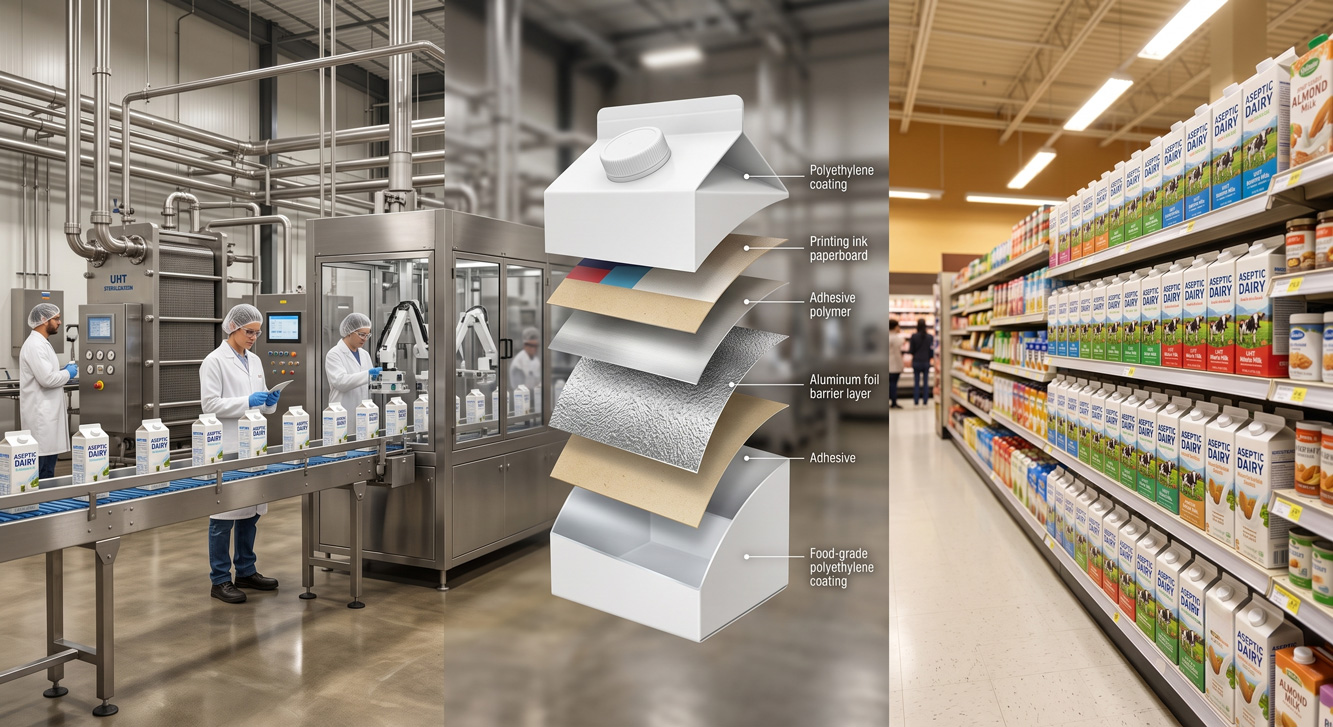


Executive Summary – Induction sealing and ultrasonic sealing represent the two most advanced sealing technologies for aseptic carton packaging. Induction sealing uses electromagnetic fields to generate heat in an aluminum layer, creating hermetic seals through conduction. Ultrasonic sealing employs high‑frequency mechanical vibrations to generate frictional heat directly at the molecular level.
A landmark 1997 study by Yeh and Benatar at Ohio State University evaluated both methods and concluded that induction sealing provides short process times with consistent quality and no foil breakage, while ultrasonic sealing, though equally fast and consistent, always causes breakage of the aluminum foil along the joint interface. For sustainable, aluminum‑free packaging, ultrasonic sealing offers distinct advantages in mono‑material compatibility and recyclability. For existing multi‑layer structures containing aluminum, induction sealing remains the superior choice for barrier integrity.
The Two Technologies Defined
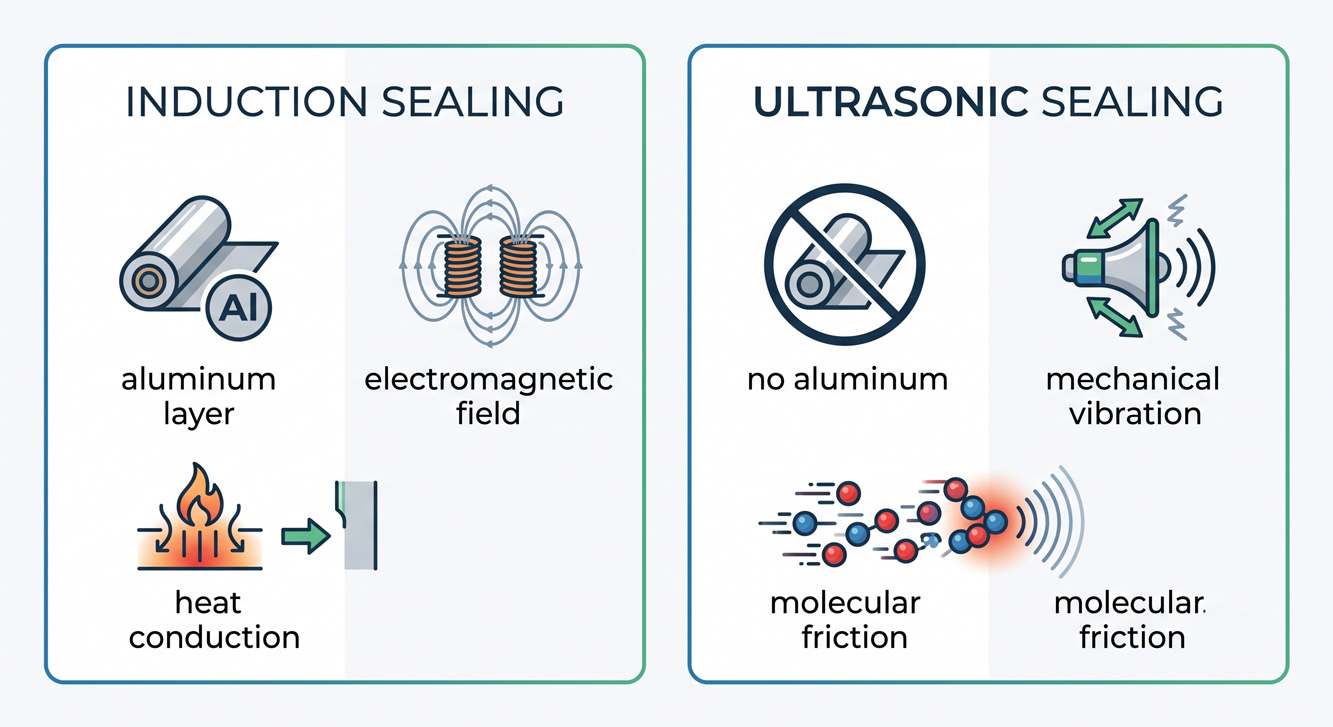
Induction Sealing: Heat Through Electromagnetic Fields
Induction sealing is a non‑contact sealing method that uses electromagnetic energy to create hermetic seals. The process requires the packaging material to contain a conductive layer—typically aluminum foil—which forms part of the carton’s barrier structure.
The mechanism works as follows:
- An induction coil generates a high‑frequency electromagnetic field
- The field induces eddy currents in the aluminum layer
- These currents generate heat through electrical resistance
- Heat transfers by conduction to the adjacent plastic laminate layers
- The plastic melts and bonds to form a hermetic seal
For aseptic packaging, induction sealing is widely used for both longitudinal seals (forming the tube from the web) and transverse seals (cutting and sealing individual packages). In high‑speed operations, induction jaws clamp, seal, and cut individual packages below the liquid level, creating hermetic seals that maintain product sterility.
Ultrasonic Sealing: Heat Through Molecular Friction
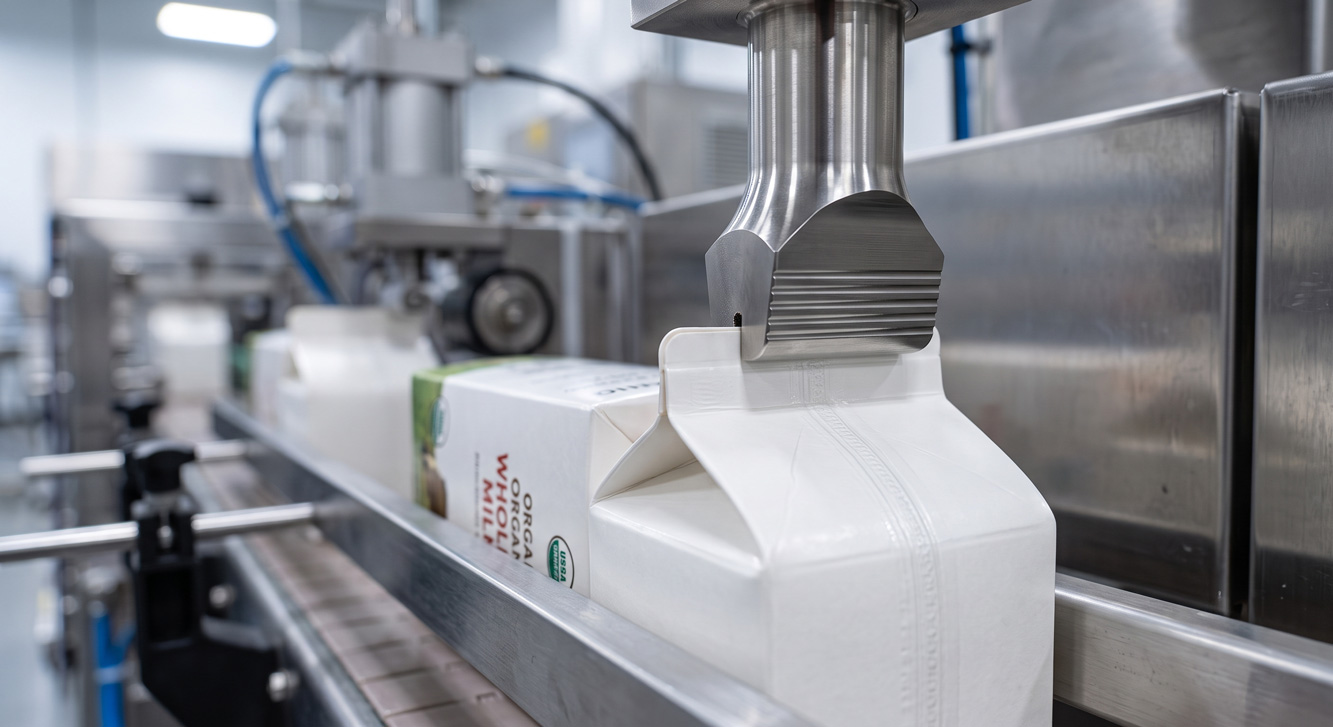
Ultrasonic sealing uses high‑frequency mechanical vibrations—typically 20, 30, or 35 kHz—to generate localized frictional heat directly at the interface of the materials being joined.
The mechanism works as follows:
- An ultrasonic converter transforms electrical energy into mechanical vibration
- A booster amplifies the vibration amplitude
- The sonotrode (horn) delivers the energy to the sealing area
- Molecular friction generates heat within the plastic layers
- The heated plastic melts and bonds under pressure
Unlike induction sealing, ultrasonic sealing does not require an aluminum layer. This fundamental difference has profound implications for packaging design and sustainability.
Head‑to‑Head Comparison: Which is Better?
Seal Quality and Barrier Integrity
The Critical Difference: The 1997 study by Yeh and Benatar at Ohio State University, which remains the definitive academic reference on this topic, found that ultrasonic sealing always causes breakage of the aluminum foil along the joint interface. This occurs due to both dynamic compression and tensile force from the squeeze flow of the molten polyethylene layer. While induction sealing achieves the same quality with no foil breakage, ultrasonic sealing’s foil fracture can compromise the barrier between air and food. This is particularly critical when considering the causes of pin-hole defects in foil lamination , as even microscopic fractures can increase oxygen transmission rates and lead to premature product spoilage.
Sustainability and Material Compatibility
The Sustainability Advantage: Ultrasonic sealing’s ability to seal without an aluminum layer is its most significant advantage. In a detailed comparative framework, ultrasonic sealing scores the highest possible rating for mono‑material sealing capability. This makes ultrasonic sealing the preferred choice for brands pursuing aluminum‑free, fully recyclable packaging. For a deeper understanding of barrier material performance, see our Masterclass on Designing Uncompromising Barrier Properties for Aseptic Liquid Packaging .
Contamination Resistance
Ultrasonic sealing offers a distinct advantage in sealing through contamination. Because the vibrations “knock off” or displace product residues from the sealing area, ultrasonic sealing can achieve reliable seals even in dusty filling environments or with product residue present.
Induction sealing, by contrast, relies on heat conduction through the material layers and can be compromised by contamination at the seal interface.
Equipment and Operational Considerations
Induction sealing is proven and widely adopted across the industry. Ultrasonic sealing, while offering superior sustainability benefits, requires careful material optimization and represents a higher initial capital investment. The choice between these technologies must also consider the broader machine architecture—whether Web‑Fed vs. Blank‑Fed —as each platform imposes different constraints on sealing technology integration.
The Impact of Sealing on Overall Aseptic Line Performance
The sealing mechanism is not an isolated process—it interacts with every other stage of the aseptic filling line. The sterilization method used—whether H₂O₂ vs. e‑Beam —can affect the surface properties of the laminate and, consequently, the sealing performance. Similarly, the choice of sealing technology influences the overall efficiency of the aseptic filling machine , with ultrasonic sealing’s cold tools enabling faster cycle times and reduced thermal stress on the packaging material.
For a comprehensive understanding of how sealing fits into the complete aseptic packaging ecosystem, refer to our Ultimate Engineering Guide to Aseptic Filling Machines .
Application‑Specific Recommendations
Choose Induction Sealing When:
| Scenario | Reason |
|---|---|
| Your carton contains an aluminum barrier layer | Induction sealing is the established, proven technology for aluminum‑containing laminates |
| Barrier integrity is your top priority | No foil breakage means the oxygen and light barrier remains intact |
| You are using existing, proven machinery | Induction sealing equipment is widely available and well‑understood |
Choose Ultrasonic Sealing When:
Summary: Which is Better?
The answer depends entirely on your packaging structure and sustainability goals:
The Verdict: There is no universally “better” technology. Induction sealing is the superior choice for traditional aluminum‑containing aseptic cartons where barrier integrity is paramount. Ultrasonic sealing is the superior choice for the future of sustainable, aluminum‑free packaging where mono‑material recyclability and energy efficiency are the primary drivers.
The ASQ Packing Advantage
At ASQ Packing Group , we engineer our multi‑layer aseptic laminates to perform with flawless precision on both induction and ultrasonic sealing equipment. Our material scientists calibrate polymer blends, aluminum layer thickness, and barrier structures to match your specific sealing technology.
Our Technical Capabilities:
- Induction‑optimized laminates with precisely controlled aluminum layer thickness for consistent, high‑speed sealing
- Ultrasonic‑optimized laminates with custom polymer blends for reliable, sustainable sealing without aluminum
- FSC‑certified paperboard from responsibly managed forests
- Expert technical support for sealing optimization across both technologies
For detailed technical insights on ultrasonic sealing, refer to our dedicated article: Ultrasonic Sealing Mechanism in Aseptic Cartons .
Frequently Asked Questions
1. What is the main difference between induction and ultrasonic sealing?
Induction sealing uses electromagnetic fields to heat an aluminum layer, which then melts the plastic sealant. Ultrasonic sealing uses high‑frequency mechanical vibrations to generate heat directly within the plastic layers through molecular friction.
2. Which method creates stronger seals?
Both methods achieve seal strengths where failure occurs in the paperboard, not in the seal itself. The key difference is that induction sealing achieves this without breaking the aluminum barrier layer, while ultrasonic sealing always causes aluminum foil fracture.
3. Does ultrasonic sealing require an aluminum layer?
No. Ultrasonic sealing can seal packaging materials without any aluminum layer, enabling mono‑material, fully recyclable packaging designs.
4. Does induction sealing require an aluminum layer?
Yes. Induction sealing requires a conductive layer, typically aluminum, to generate heat through eddy currents. Without aluminum, induction sealing cannot function.
5. Which method is better for sustainable packaging?
Ultrasonic sealing is generally better for sustainability because it enables aluminum‑free, mono‑material packaging that is easier to recycle.
6. Which method is more energy‑efficient?
Ultrasonic sealing consumes significantly less energy—up to 75% less than other welding processes—particularly for thicker films and materials containing aluminum.
7. Can ultrasonic sealing seal through contamination?
Yes. The vibrations displace product residues from the seal area, enabling reliable seals in dusty or contaminated environments.
Ready to Choose Your Sealing Technology?
Whether you are evaluating induction sealing for traditional aluminum‑containing cartons or ultrasonic sealing for sustainable, aluminum‑free packaging, ASQ Packing Group has the technical expertise and manufacturing capability to support your decision.
👉 Contact us at ASQ Packing to discuss your sealing requirements, request samples, or schedule a technical consultation.